
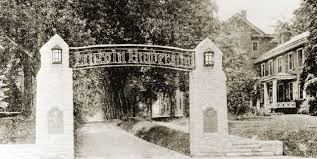
Image courtesy of Facebook
Written by: Atif Ward & Nevaeh Washington
Lincoln University, PA—The founding of Lincoln University represents a complex interaction of ideology, community, migration, and global Black identity that continues to shape the institution’s legacy today. Established in 1854 as Ashmun Institute, the university emerged at the intersection of multiple historical forces, including colonization debates, missionary activity, and the growth of free Black communities in the Mid-Atlantic region. The period leading up to its founding was marked by national anxieties about slavery, growing Black intellectual culture, and white attempts to control the destiny of African-descended people.
Many of these tensions were embodied in the work of the American Colonization Society (ACS), which profoundly influenced the ideological backdrop in which the school was created. Understanding these intertwined contexts is essential to fully appreciating the institutional origins and significance of Lincoln University. The role of the ACS, and particularly figures such as Jehudi Ashmun, reflects the complicated relationship between early Black education and colonizationist ideology.
The ACS argued that Black freedom and American citizenship were incompatible and that free African Americans should be relocated to Liberia, a position that created deep divisions within Black communities. Ashmun, a missionary and political figure in Liberia, embodied the colonization movement’s belief that Christian education and “civilization” should flow outward from the United States to Africa. Although Ashmun Institute was named in his honor, Black abolitionists widely criticized the ACS for promoting racial hierarchy under the guise of benevolence.
Even so, the institute would eventually become a space where Black students transformed missionary education into tools for empowerment, resistance, and leadership across the Diaspora. The involvement of Reverend John Miller Dickey, the school’s founder, further demonstrates the ideological conflicts embedded in Lincoln’s origins. Dickey’s worldview was shaped by missionary theology and the belief that educated Black leaders were necessary to spread Christianity in Africa. Yet his decision to build the school in the free Black settlement of Hinsonville reveals an institutional origin deeply tied to Black community strength rather than solely to white missionary goals.
Dickey saw Hinsonville as a promising environment with a growing Black population, but the community already had its own leadership structures, religious networks, and educational ambitions independent of outside intervention. This means that Lincoln’s history is rooted not just in white philanthropy, but also in the intellectual and social agency of free Black Pennsylvanians.
Hinsonville itself stands as a testament to the power of Black self-determination before the Civil War. Founded by free African Americans and formerly enslaved people who fled the South, it became a thriving settlement long before Lincoln University existed. Residents built homes, cultivated land, established churches like Hosanna Church, and formed a network of safety and opportunity in defiance of national constraints on Black freedom.
Their community served as a fertile ground for early students at Ashmun Institute and later at Lincoln University, providing a foundation of social support, cultural continuity, and political consciousness. In this sense, Hinsonville was not simply the location of the university—it was its earliest intellectual and cultural anchor. The early students at Ashmun Institute, including the Amos brothers, illustrate a generation of African-descended scholars whose ambitions pushed against the boundaries of missionary education.
While the school’s curriculum emphasized classical languages, theology, and Western intellectual traditions, these students transformed such training into vehicles for advancing the global Black freedom struggle. Their missionary work in Africa reflected not only the religious goals of the institution but also the agency of African Americans seeking to shape global Christianity and Black identity on their own terms. The participation of these early students shows how Lincoln’s foundation became a launching point for international Black leadership, diplomacy, and community-building.
Their lives are a reminder that the university’s early global reach was shaped by its students as much as by its founders. Today, understanding the founding of Lincoln University allows us to better appreciate how its earliest years shaped its ongoing mission. Its origins are marked by contradictions—between colonization and citizenship, missionary goals and Black self-determination, westernization and cultural preservation, and white philanthropic intentions and Black intellectual autonomy.
Yet out of these tensions emerged a university that would become one of the most influential institutions in the African diaspora, educating leaders who transformed local communities, national politics, and global movements. Lincoln University’s founding is therefore not a simple story, but a layered narrative shaped by conflict, collaboration, and the long struggle for Black dignity and freedom.
As we reflect on this history, we honor the community, resilience, and vision that have always defined Lincoln University